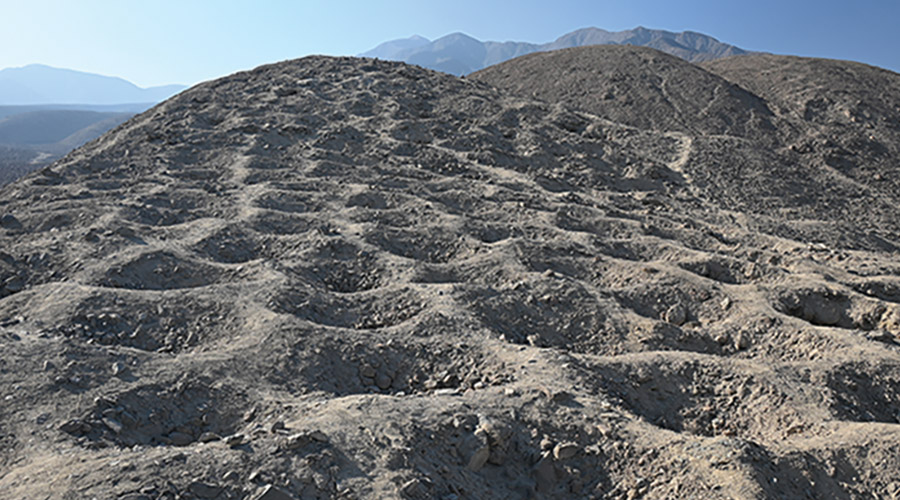
If you didn’t know better, you’d assume the hillside had been hit by something violent — a storm of falling rock, a freak geological collapse, the kind of natural chaos that leaves the land permanently scarred. But the closer you get to Monte Sierpe in southern Peru’s Pisco Valley, the more unsettling the truth becomes: this isn’t damage. It’s design.
The slope is covered in pits — not a few scattered depressions, but thousands of deliberately carved holes, arranged in long lines and tight blocks that stretch across the ridge. Their placement looks methodical, almost mathematical, like someone once followed an invisible grid and refused to stop until the job was done. From above, the site doesn’t read like a ruin so much as a system that’s been frozen in time.
For nearly a century, that’s been the problem. Archaeologists have been staring at the “Band of Holes” for decades, and the landscape has been staring right back — offering scale and precision, but no obvious explanation.
A Mystery Etched Into the Earth
What makes this place so difficult to categorise is that it doesn’t behave the way famous ancient sites usually do. There are no towering stones, no carved figures, no inscriptions announcing its purpose. Just holes — around 5,200 of them, cut into the hillside in a way that implies time, labour, and planning on a serious scale.
Early theories went in every direction. Some suggested graves. Others leaned towards storage pits, defensive strategies, or agricultural functions. Theories multiplied because none of them fully fit. The holes were too uniform, too numerous, and too organised to feel accidental — but also too strange to confidently explain as a normal settlement feature.
Then modern researchers tried a different approach: instead of asking what the site looked like, they asked what it did.
The Breakthrough: Drones, Dirt, and Microscopic Clues
A recent research effort mapped Monte Sierpe in far greater detail than ever before, using high-resolution drone imagery to study its layout and patterns across the ridge. What emerged wasn’t just a long smear of holes — it was a structure divided into sections, with repeated blocks and counts that hint at intentional organisation rather than random digging.
But the real turning point came from looking inside the holes themselves.
By analysing soil and plant traces — including microscopic botanical remains — researchers found evidence that suggested these pits weren’t simply empty scars in the landscape. They likely held things. Goods. Produce. Materials moving through the valley.
Among the finds were traces consistent with crops that don’t naturally belong on that arid hillside, including maize, along with other plant materials associated with human handling and transport. The implication is subtle but powerful: this wasn’t a purely “natural” surface. It was a working space.
An Ancient Marketplace — Carved Into a Mountain
The most compelling theory now is also the most human: the Band of Holes may have functioned as an Indigenous system of exchange and accounting — a place where people met to trade, measure, and manage goods in a world without paper ledgers or warehouses.
Rather than imagining the site as a single-purpose monument, this interpretation treats it as infrastructure — a physical solution to an economic problem. In its prime, Monte Sierpe may have acted as a sort of open-air, organised marketplace where goods could be portioned out, temporarily stored, or arranged in ways that made transactions visible and verifiable.
In other words, the hillside itself may have been turned into a record-keeping tool — a way to track value through space, with each pit representing a unit that could be counted, filled, or cleared.
It sounds oddly modern until you remember how sophisticated ancient trade networks could be, especially in a region shaped by different ecological zones and long-distance movement. Monte Sierpe sits in a landscape that would have made it an ideal meeting point: positioned between environments, connected by routes where goods and people could converge.
Chincha Origins, Inca Afterlife
Timing matters here. Evidence points strongly to the site being actively used during the Late Intermediate Period (around AD 1000–1450) — a period linked in the region to the Chincha Kingdom, known historically as skilled traders with significant influence before the Inca expanded into the area.
But Monte Sierpe may not have belonged to just one era. Researchers also argue that the site likely saw continued use into the Inca period, suggesting a fascinating possibility: what began as a local trading and exchange system may have later been absorbed into imperial administration.
That’s where the story gets even more interesting. The Inca were famous for their record-keeping, including the use of khipu — knotted-string systems used to store and manage information. The Band of Holes, with its segmented blocks and repeating numerical logic, has been compared to a kind of landscape-scale counterpart to those accounting traditions.
The Mystery Isn’t Over — and That’s the Point
Even with stronger evidence and smarter tools, Monte Sierpe refuses to be reduced to a neat one-line answer. Some scholars remain cautious, noting that not every pattern aligns perfectly with what we might expect from later imperial systems. The site may have had more than one purpose, or it may have changed over time — shaped by the needs of different people across generations.
But maybe that’s exactly why it’s such a compelling place to stand in your imagination. The Band of Holes doesn’t feel like a myth or a legend — it feels like the ghost of a working world. A reminder that ancient societies weren’t only building temples and tombs. They were also building systems: methods for organising food, labour, travel, and trade at scale.
And somewhere on a hillside in Peru, that system is still visible — thousands of pits, waiting quietly in the sun, asking the same question it’s always asked:
What kind of civilisation makes a mountain into a ledger?
Featured Image Credit: USF.Edu