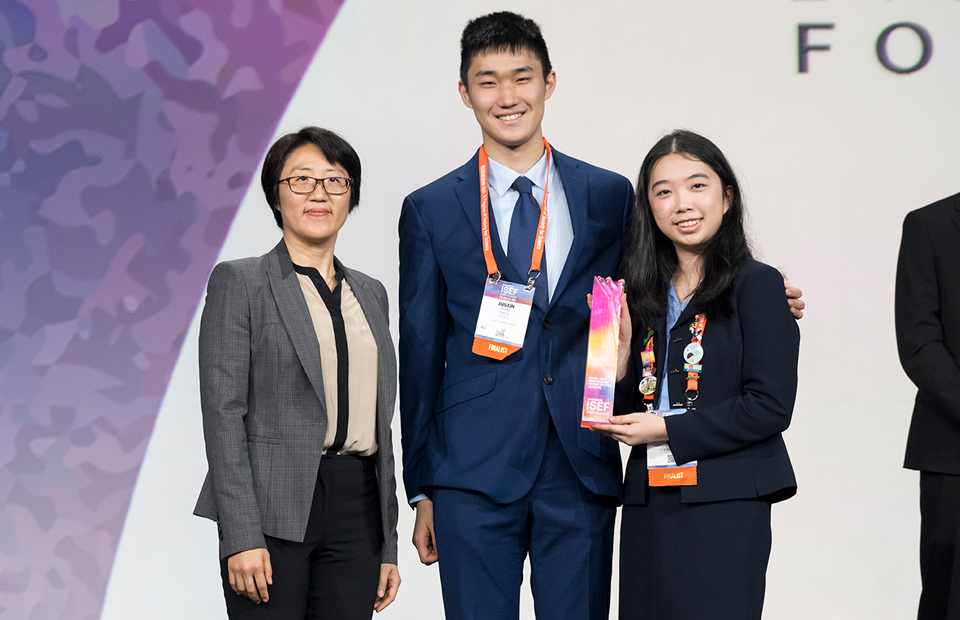
A glass of water can look pure, even sparkly. Yet tiny plastic specks can still drift inside it, too small to spot, too sneaky for many filters to catch. Researchers continue to find microplastics in places that concern people, including human bloodstreams and placentas. In The Woodlands, Texas, two teenagers set out to tackle that hidden menace with an idea that sounds like science fiction. They decided to use sound to move plastic.
A Workshop, a Problem, and a Wild Question
High school students Victoria Ou and Justin Huang studied water samples contaminated with microplastics, the microscopic shards that can come from broken-down bottles, synthetic fabrics, and industrial waste. Many standard filters struggle to capture the smallest particles because some microplastics are smaller than a grain of sand.
So the teens stepped away from the usual “make the filter finer” approach. They explored acoustics, the science of sound waves. They believed that sound could physically move floating plastic fragments and group them into a more easily removable mass.
That belief prompted them to undertake serious experiments. They employed physics, rigorous calculations, and repeated testing. They aimed for one thing: make tiny plastic pieces stop acting like dust and start acting like something a filter could actually grab.
How Sound Started Acting Like an Invisible Magnet
Ou and Huang developed a device that used ultrasound, sound waves at frequencies inaudible to humans. They tuned those waves to create an invisible pushing force in water.
Their system used acoustic trapping. Ultrasound moving through water forms pressure patterns. Those pressure zones guide particles through the liquid. In the teens’ design, the zones induced microplastics to move toward one another until the scattered fragments formed tight clusters.
Once the plastic bits gathered into clumps, the job became simpler. A conventional filter could capture those larger clusters more readily than it could capture countless tiny fragments dispersed throughout the water.
The teens did not add chemicals. They did not depend on expensive membranes. They relied on sound and the physical forces it creates in liquid.
Results That Made Judges Pay Attention
Testing showed strong performance. The teens reported that their method removed up to 90 per cent of microplastics in a single pass through the system.
That number mattered because microplastic pollution is increasing rapidly, and many water-treatment approaches either require substantial infrastructure or involve chemical processes. Judges at a top global science competition saw the teens’ approach as a fresh way to attack a stubborn problem, using compact technology instead of huge facilities.
Small Enough to Carry, Big Enough to Matter
Microplastics are present in oceans, rivers, and drinking water supplies. Communities with limited resources often face the most severe challenges when water quality declines. A compact, power-efficient tool could help in areas that cannot build large-scale treatment plants.
Reports about the invention describe it as compact, with a concept that could fit in the palm of a hand. The teens also aimed for low energy use, which could make the approach more practical in remote areas or emergency situations where power is scarce.
This does not mean the world can deploy it everywhere tomorrow. The work remains at the prototype stage. But the core idea carries real promise: instead of trying to trap tiny plastic specks one by one, the device herds them together, then lets a basic filter finish the job.
A Huge Prize for a High School Breakthrough
Ou and Huang presented their invention at the Regeneron International Science and Engineering Fair (Regeneron ISEF), one of the world’s biggest science competitions for high school students. Their project stood out among thousands of entries from across the globe.
The judges awarded them the Gordon E. Moore Award for Positive Outcomes for Future Generations, along with a US$50,000 prize. Media coverage followed quickly. Multiple outlets highlighted the unusual method and the strong removal results.
Why This Story Feels So Unbelievable
Most people picture clean-water breakthroughs coming from billion-dollar labs. Ou and Huang showed another path. They used curiosity, experimentation, and school-level resources to build something that grabbed international attention.
They have also signalled interest in refining the device and exploring how the technology could scale. Future testing will decide how well the method performs across different real-world water conditions. Even so, the core discovery already lands like a plot twist: sound waves can organise invisible plastic into clumps that a filter can catch.
When two teenagers make physics do the dirty work, the result feels almost unreal. Yet their ultrasound tool delivers a simple message that hits hard. The future of clean water might arrive with a hum you cannot hear.
Featured Image Credit: Society for Science