On a quiet stretch of desert highway in the United Arab Emirates, a stretch of asphalt is secretly singing Beethoven. No speakers. No screens. No conductor, no orchestra. And yet, if you drive at exactly 60 kilometres an hour, the road itself performs “Ode to Joy”, the fourth movement of Beethoven’s Ninth Symphony, using nothing but your tyres and physics. Miss the speed limit and the music distorts into chaos. Hold it steady, and the pavement turns into a classical instrument.
Beethoven, Engine-Induced
Built on the Sheikh Khalifa bin Zayed Road in Fujairah, the musical highway looks ordinary at first glance, just another road slicing across sand. But embedded beneath your wheels are carefully engineered rumble strips, positioned at precise distances. They work exactly like the grooves of a vinyl record, except instead of a needle, your tyres do the playing. The UAE installed the project not for entertainment, but as a speed management tool. Instead of warning signs, drivers are rewarded with Beethoven for obeying the law.
According to Reuters and AP News, the tune isn’t accidental or a gimmick. It is intentionally calibrated to play in tune only at 60 km/h, slow down or speed up, and Beethoven instantly falls apart. Locals call it both mesmerising and mildly terrifying, as the difference between symphony and screeching noise is barely a twitch of the accelerator.
A Growing Global Phenomenon
Musical roads aren’t entirely new. Japan experimented with them in Hokkaido and Gunma prefectures. The Netherlands built one in Friesland that accidentally traumatised residents because the melody played nonstop as cars passed all night. South Korea, Denmark, Taiwan, Indonesia, many countries have tried. Most were novelty projects. Few were engineered with this precision. None until now played one of humanity’s most iconic compositions.
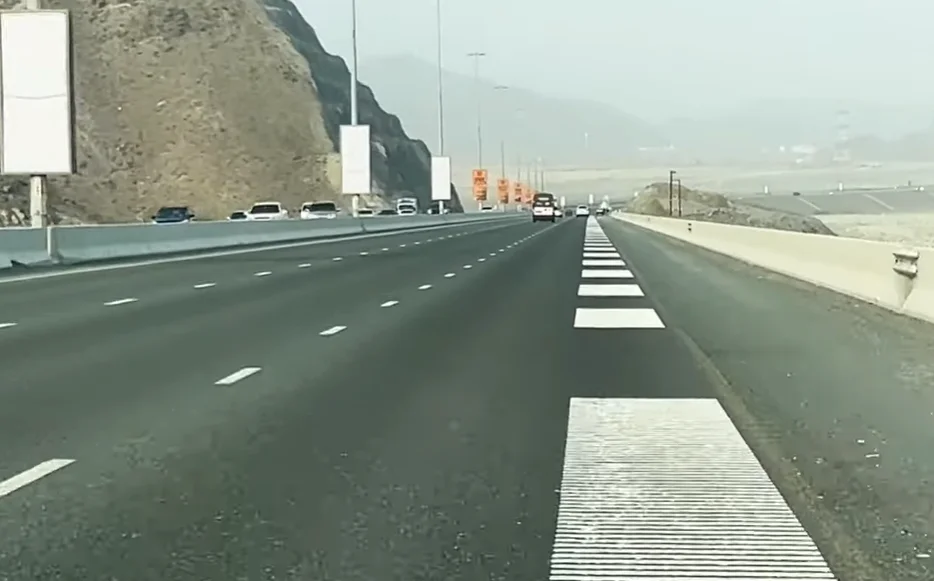
The UAE’s version isn’t meant to be TikTok bait, but officials aren’t pretending it isn’t a tourism magnet. Videos circulating online show first-time drivers physically laughing in disbelief as their car stereo fades and the road begins to sing without warning. Families have begun coming here solely to experience it. One driver called it “the only road on Earth where speeding literally ruins Beethoven.”
A Symphony With a Moral
This isn’t just infrastructure. It’s behavioural psychology in bitumen. The project frames speed compliance not as punishment, but participation. You don’t slow down to avoid a fine, you slow down to join the orchestra. In a country known for supercars and 200 km/h highway displays, it is arguably the softest, cleverest, most poetic way to make people behave.

And yet the most extraordinary part is that the highway doesn’t play to the driver. It plays with them. You become part of the instrument. Your tyres are the bow. Your speed is the tempo. Road safety becomes music theory. And Beethoven, two centuries after his death, gets one more stage, in the middle of a desert, powered by Toyotas and Teslas.
The Road That Refuses to Be Background
For decades, driving was something you did passively, half-distracted with mobile phones, playlists, and muscle memory. This road interrupts that autopilot. It asks for attention. And scientifically, it locks it. The UAE has hinted this won’t be the last. Test data reportedly showed lower accident rates almost immediately. And if the experiment scales, the future may look like this: every road with its own song, every commute a soundtrack, and speeding punished not by fines, but dissonance.
Beethoven once wrote that music “can change the world.” He probably didn’t imagine asphalt as the instrument. But then again, genius tends to age well.