Imagine setting off a fuse that ignites a blazing staircase into the stars, not for fame, not for fortune, but for one person: your 100-year-old grandmother, watching from her sickbed. This isn’t a myth, a movie, or magic. This is real. Meet Cai Guo-Qiang, the Chinese artist who turned gunpowder into poetry and spent 21 years trying to build a ladder of fire to the sky. And when he finally pulled it off? It lasted just 150 seconds. But those two and a half minutes were so jaw-droppingly beautiful, they’ll probably echo in art history for centuries. Spoiler: Grandma saw it. And yes, she cried.
The Boy Who Lit the Sky
Born in Quanzhou, China, Cai Guo-Qiang grew up during the Cultural Revolution, where art was political and imagination was risky. But his father, a traditional calligrapher, taught him to dream in ink, and later, in fire. As a kid, he’d sneak gunpowder from local fireworks, convinced it wasn’t just for noise, but for art. One early experiment nearly burned down the family living room. (His grandmother famously saved the day, and the furniture.)

He didn’t stop. Fast forward to 1994: Cai, now an internationally acclaimed artist, tried his first Sky Ladder in Bath, England. It failed. Then again in 2001 in Shanghai. And in 2012, Los Angeles said no to flaming sky-stairs. Airspace rules, weather, bureaucracy, all said “nah.” But Cai? He just smiled and said, “Next time.”
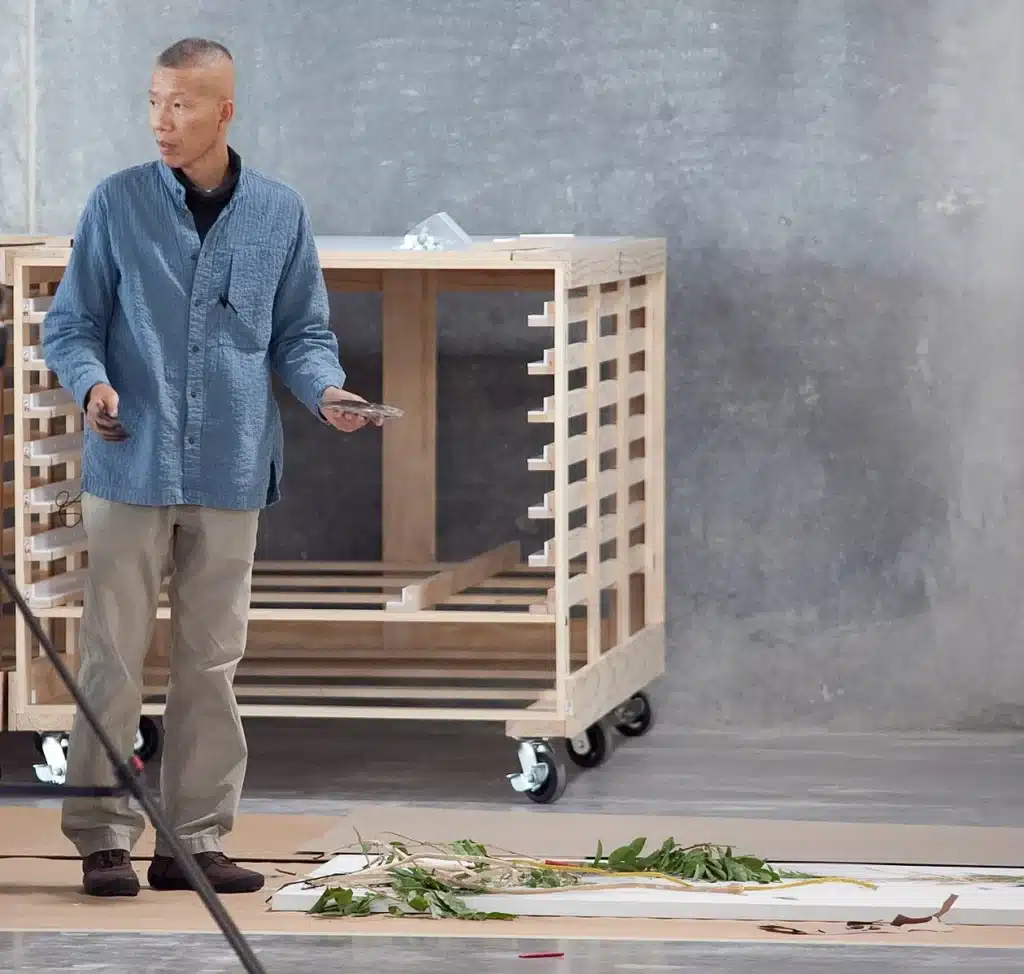
“I like taking risks,” he once admitted. “That’s what drives my work.” He even smuggled homemade explosives into the U.S. nuclear test site in Nevada in 1996 to create a mushroom cloud tribute, with a lighter. (Don’t try this at home, kids.)
A Dream 21 Years in the Making
By 2015, Cai was already famous, he designed the fireworks for the 2008 Beijing Olympics, seen by an estimated one billion people. But none of that mattered to him like Sky Ladder, a childhood dream of building a bridge to the heavens, “to touch the clouds,” as he put it.
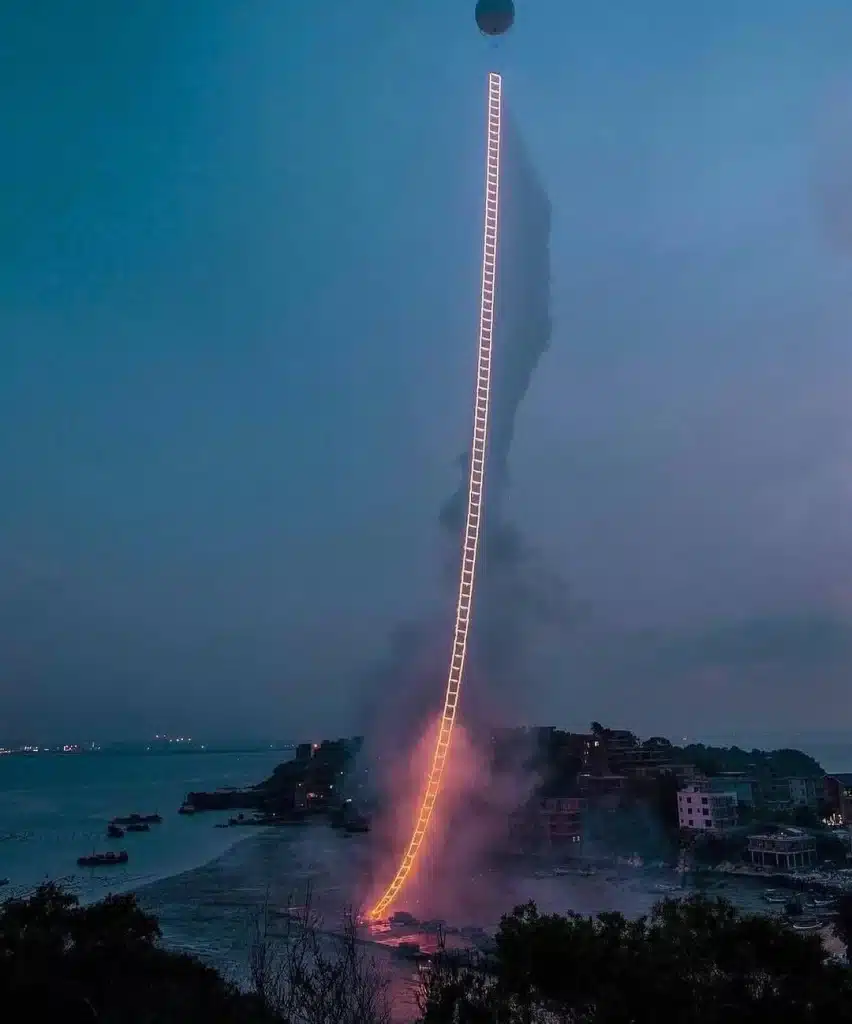
This time, he went back to where it all began: Huiyu Island, near his hometown. No permits. No government approval. Just secrecy, local fishermen, and a giant helium balloon holding a 1,650-foot rope threaded with gunpowder. Total cost? A small fortune. His wife called it “burning money.” But Cai didn’t care.
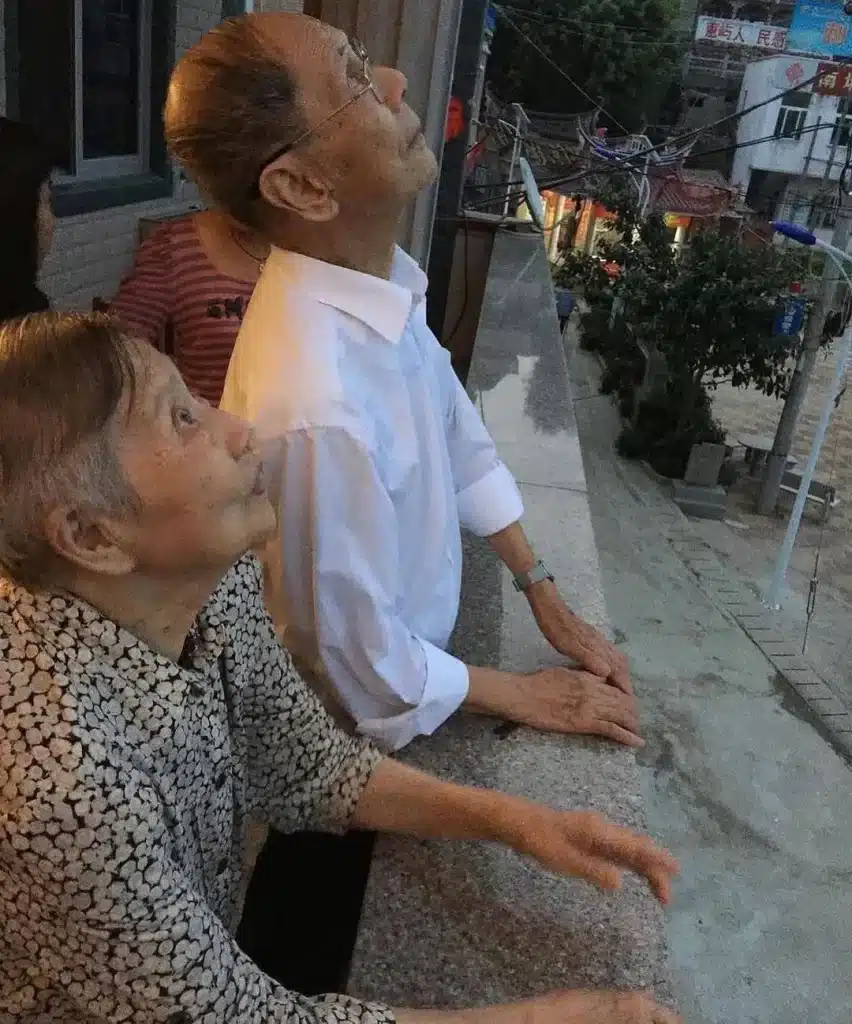
His grandmother, frail and bedridden, had never seen any of his grand projects. This one would be different. This one was for her.
The Two-and-a-Half-Minute Miracle
At 4:45 a.m. on a quiet June morning, the fuse was lit. Up it went, a roaring, crackling, golden ladder of fire, climbing into the dark sky like a message to the universe. For 150 seconds, flames danced in perfect symmetry, a fragile, fleeting masterpiece. And 100 kilometres away, on a cracked phone screen, a centenarian woman watched in awe.
“I’ve done projects all over the world,” Cai said, “but my grandmother was never able to see any of them. This one was for her.” Afterward, he called her: “You can go back to sleep now.” She smiled. A month later, she passed away. The Sky Ladder became her final gift, and his most personal explosion yet.
Art That Burns Out, But Never Fades
Cai doesn’t believe art should last forever. “I don’t think any art is meant to be kept immortal,” he said. Instead, he chases the ephemeral, the flash, the fear, the feeling. His work isn’t in galleries; it’s in the gasp of a crowd, the silence after a blast, the tear on an old woman’s cheek.
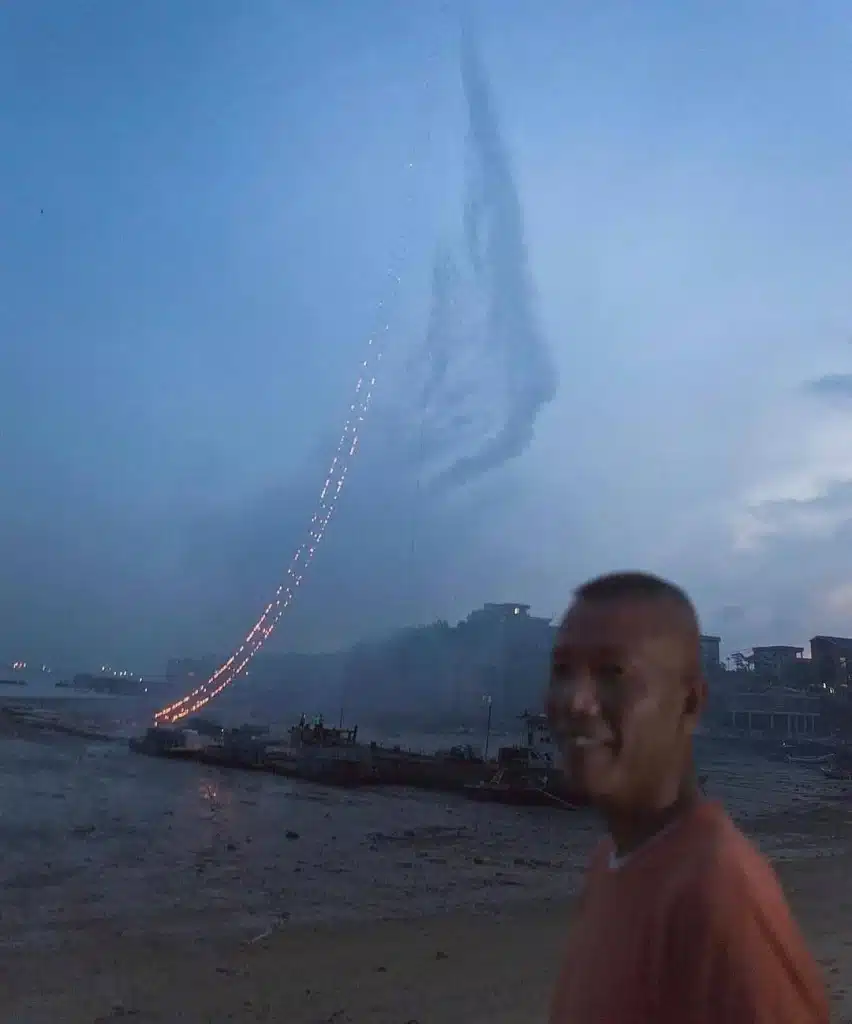
The Sky Ladder was filmed for the Netflix documentary Sky Ladder: The Art of Cai Guo-Qiang, directed by Oscar-winner Kevin Macdonald. It’s less a story about fireworks and more about a son’s love, a grandson’s promise, and the wild, irrational persistence of a dream.
Cai once said the most powerful art comes with fear. Maybe he meant the fear of failing. Or the fear of saying goodbye. Or the fear of lighting a fuse that might not ignite, but does, just in time.