Dust rises before sound on the far edge of California’s desert. Wind pushes across cracked concrete, rattles loose metal, and slides through pallet walls that never fully close. Sand settles into corners that were never meant to exist. In this exposed place, shelter works differently. This is Slab City, an off-grid settlement with no municipal power, plumbing, rent, or formal housing, built on what the military left behind.
Concrete Left Behind
Slab City stands on the remains of Camp Dunlap, a United States Marine Corps training base commissioned in October 1942 during World War II. The base once contained roads, water systems, and sewage infrastructure. By 1956, the military dismantled its buildings and removed usable materials, but the concrete foundations stayed. Those slabs scattered across the sand became the physical base for an informal settlement that followed.
In 1961, the Department of Defense transferred the land to the State of California. The area remained remote and harsh, defined by heat, dust, and distance from services. Over time, people began to arrive. Early residents included veterans connected to the base, followed by drifters and workers drawn to the surrounding region. By the 1980s, recreational vehicle owners discovered the site as a free winter camping area near the Salton Sea. The exposed foundations gave the place its name, and Slab City took shape without formal planning.
A City Without Bills
Life in Slab City operates outside conventional systems. Residents typically occupy land informally rather than through property titles. There are no rent payments, no utility accounts, and no property taxes. People arrive, find a space that appears unclaimed, and build.
Shelters vary widely. Some live in RVs or tents. Others construct trailers, shacks, yurts, or pallet-built structures. Electricity comes from solar panels, generators, or batteries. Water requires regular trips to nearby Niland, roughly four miles away. Sewage disposal and rubbish management rely on individual effort. These conditions require residents to organise their own basic services every day.
Population changes with the seasons. During the cooler months, numbers rise to around 4,000 as snowbirds arrive from across the United States and Canada. When summer heat climbs past 40 degrees Celsius, most leave. About 150 people remain year-round, enduring temperatures that can reach 50 degrees Celsius.
Rules Without Lawbooks
Slab City often carries a reputation for lawlessness, but it does not exist outside the law. State and federal laws still apply. Law enforcement patrols pass through regularly, and emergency services respond when called. School buses collect the few children who live in the settlement. Delivery trucks from major carriers travel its dirt roads.
Order comes from informal norms rather than local government. Residents describe a strong expectation to mind personal affairs. Theft brings social consequences through shunning rather than violence, and residents report that vigilantism remains rare. Drug use exists, but locals say it tends to remain concentrated in known areas rather than dominating daily life.
Many residents rely on bartering, trading, and shared know-how alongside these informal rules. The system functions through cooperation rather than enforcement.
Art in the Heat
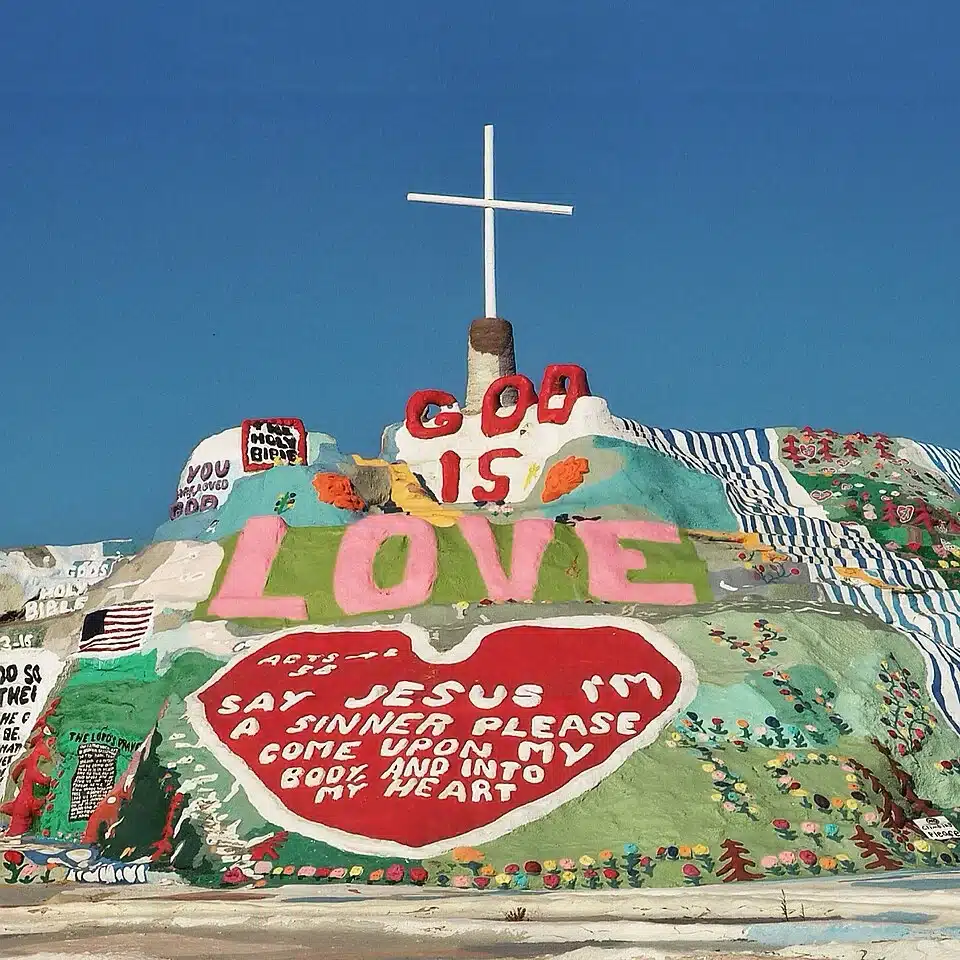
Art shapes Slab City’s identity. Near the highway stands Salvation Mountain, a brightly painted structure built from adobe, concrete, and layers of donated paint. Leonard Knight began building it in the 1980s and worked on it for decades. In 2002, the site gained recognition as a nationally significant piece of folk art. Knight died in February 2014, but the mountain remains a defining landmark.
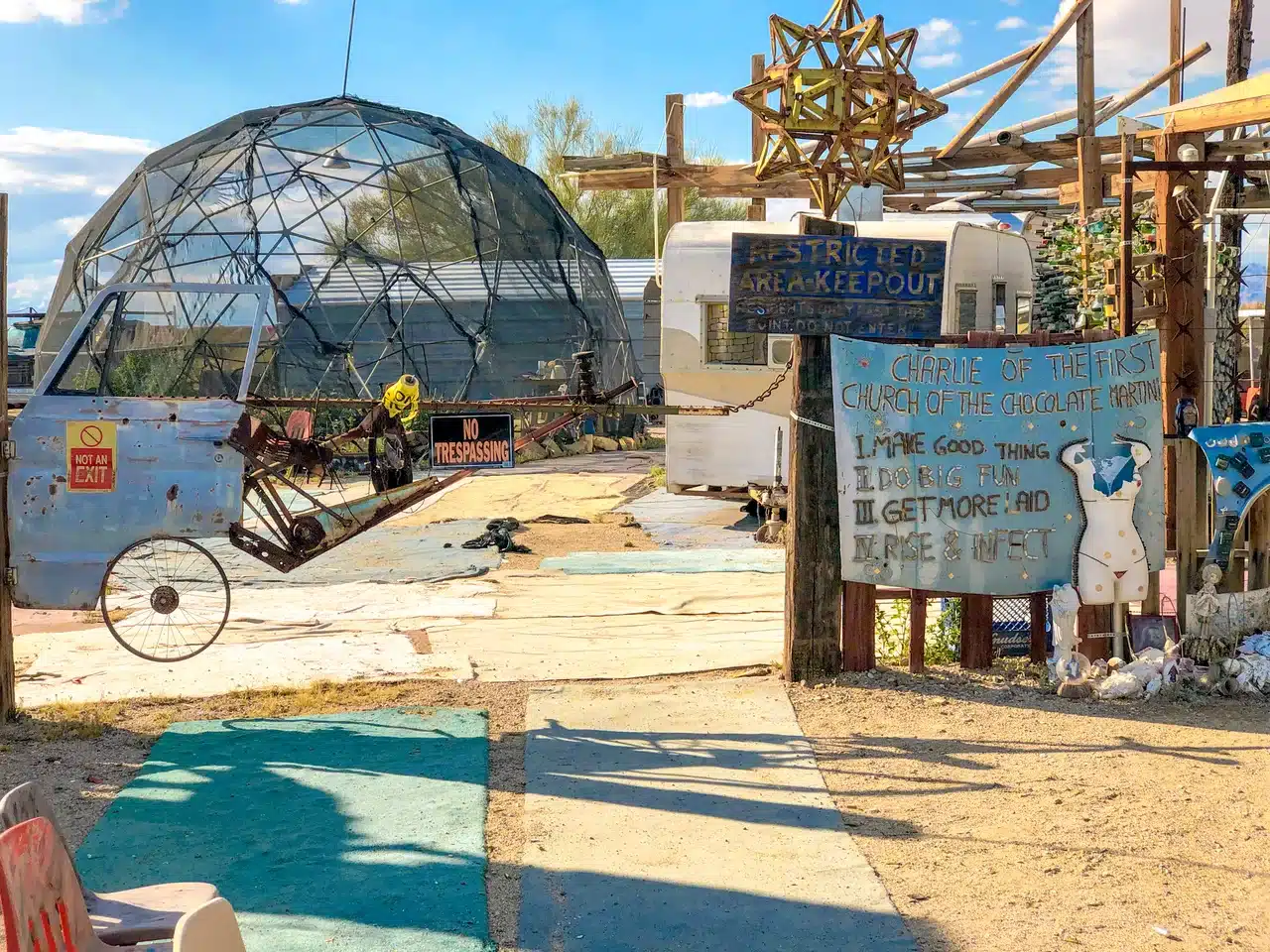
Nearby, East Jesus operates as an experimental art compound filled with sculptures made largely from reused materials. Artists live and work among installations that constantly decay under desert conditions. Heat, wind, and sand ensure nothing stays the same for long.
The Range serves as a community gathering place. It hosts Saturday night performances and an annual prom. Many residents never attended one before arriving in Slab City. These events offer breaks from isolation. Residents commonly cite boredom as one of the settlement’s most persistent challenges.
Built to Be Temporary
Architecture in Slab City reflects constant change. Some pallet structures appear and disappear within months. Residents rebuild, relocate, or abandon shelters as conditions shift. Builders often reuse and repurpose whatever materials are available, including pallets, shade cloth, and other salvaged items.
Dust storms test every structure. When wind sweeps across the flats, porous shelters allow sand inside. Some residents retreat into sealed vehicles or trailers. Others rely on imperfect windbreaks and wait for the storm to pass.
An Uncertain Horizon
Slab City’s future remains unresolved. In 2015, the state considered dividing and selling the land. No sale followed, but residents continued to express concern about displacement. The land falls within a framework historically linked to funding public education, and the state has considered appraisal and potential cleanup due to leftover military waste.
Some residents formed groups to explore land trusts as a form of protection. Reports also describe disagreement within the community over formal solutions. Slab City’s informal status provides flexibility but also creates vulnerability.
The desert sets its own pace. Concrete slabs remain where buildings once stood. Shelters rise, fall, and rise again. Slab City persists through constant change, shaped by heat, dust, and the people who come and go. When the wind finally settles, the slabs still wait.
Photo Credit: Wikipedia