Suspended above the Lauterbrunnen Valley and reached only by rail and cable, Mürren remains one of Europe’s most striking car-free settlements, shaped by steep terrain, quiet routines and gravity-defying access.
High above a sheer rock wall in the Swiss Alps, a glass cabin rises almost straight into the sky. Snow-dusted pines fall away beneath it. The valley tightens into a ribbon of green and white. In just four minutes, the ascent ends and a historic mountain village appears, balanced on a narrow terrace carved into stone. This is Mürren, a settlement that functions without roads and arrives only by cable and rail.
A Village That Never Made Room For Cars
Mürren sits at 1,638 metres in the Bernese Oberland, facing the vertical walls of the Lauterbrunnen Valley. No public road reaches the village. For centuries, residents moved supplies by mule, descending to the valley on foot and climbing back up with essentials. That isolation shaped daily life long before tourism arrived.
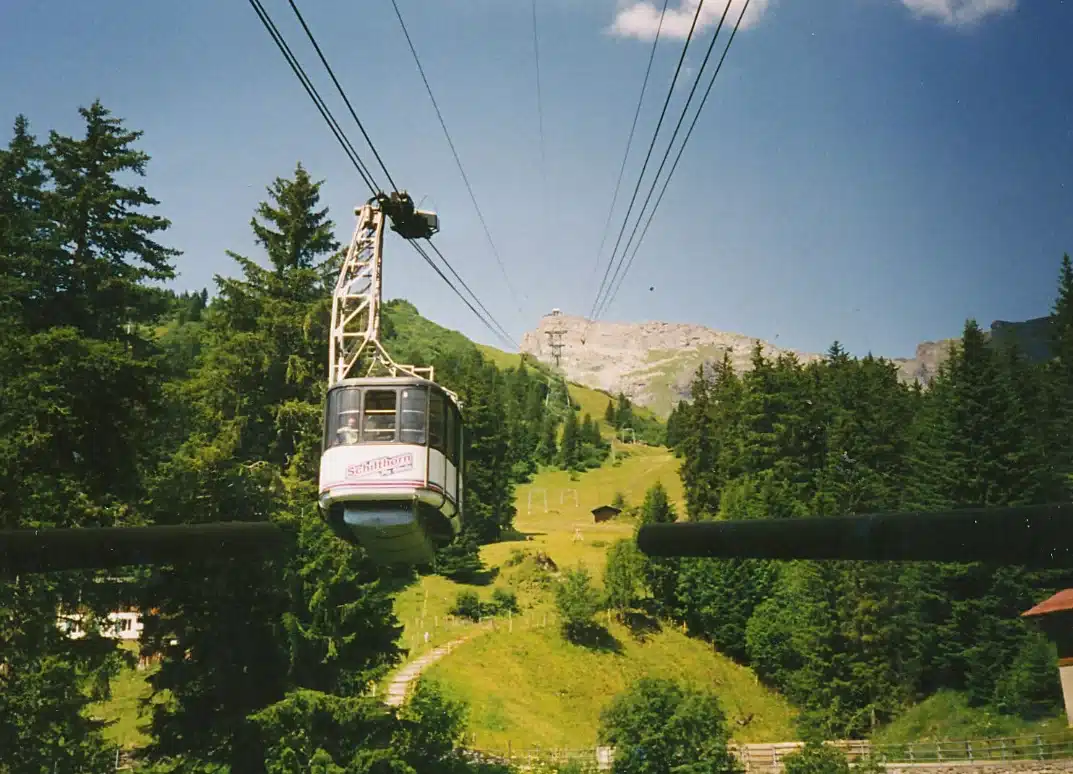
Change came gradually. In 1891, a narrow-gauge railway connected Mürren to Grütschalp, linking to a funicular down to Lauterbrunnen. Cable cars followed, threading steel lines across cliffs and forests. In late 2024, the Schilthornbahn opened, directly linking Mürren to Stechelberg through the steepest cable car ascent in the world. The cabins climb a 159.4 percent gradient, lifting passengers 775 metres in four minutes through exposed alpine terrain.
Life At The End Of The Line
Mürren remains car-free by necessity. Streets belong to boots, sleds and skis. Children commute to school by cable car. Groceries and freight arrive by rail. When residents need medical care, specialist services or personal appointments, they travel down to the valley, where many keep their cars.
The village dates back to the 13th century. Timber chalets and stone cottages cling to the cliff edge, framed by narrow paths and open views. Inns and small hotels line the main streets, serving Alpine fare and shelter from winter weather. One landmark still carries its original ambition. The Mürren Palace opened in 1874 and earned the nickname Switzerland’s first palace. After reopening in December 2024, its former ballroom now hosts breakfast beneath tall windows overlooking the peaks.
From balconies and terraces, the skyline remains fixed on three mountains: the Eiger, Mönch and Jungfrau.

Where Modern Ski Racing Took Shape
Winter transformed Mürren’s future. British skiers arrived in the late 19th century, drawn by reliable snow and long descents. By 1922, the village hosted the world’s first slalom races. In February 1931, Mürren staged the first Alpine World Ski Championships, securing its place in ski history.
Today, the surrounding mountains offer more than 50 kilometres of pistes linked by lifts, chairlifts and funiculars. Snow often blankets village streets until late February, allowing skiers to move directly between slopes and accommodation. Each January, the International Inferno Race returns. The amateur downhill runs nearly 16 kilometres from the Schilthorn to the valley floor, making it the longest race of its kind. The 2026 event runs from 21 to 24 January.
When Snow Gives Way To Water And Grass
As winter retreats, Mürren shifts pace. Hiking trails wind through meadows and forests, connecting viewpoints above the valley. The Flower Trail near Allmendhubel blooms through summer, supported by altitude that extends the season for alpine plants.
Water defines the landscape. The Mürrenbach Falls plunge 471 metres in five cascades, making them the highest waterfall in Switzerland. Nearby, the Trümmelbach Falls channel glacial melt through tunnels carved inside the mountain. Paragliders launch from high points around the village, drifting above cliffs, lakes and scattered waterfalls.

A Summit That Turns With The World
Cable cars continue beyond Mürren to the Schilthorn, rising to 2,970 metres. At the summit sits Piz Gloria, a rotating restaurant that completes a full circle every hour, revealing views of more than 200 mountain peaks. The site entered popular culture in 1969 after featuring in the James Bond film On Her Majesty’s Secret Service. Today, viewing platforms and exhibitions share the peak with wind and open sky.
Holding Steady Above The Valley
Mürren’s year-round population numbers only a few hundred, yet the village supports schools, churches and seasonal workers. Residents describe a place that demands planning and rewards consistency. Seasons set the rhythm. Winter narrows movement and expands the ski area. Summer opens paths and quiet evenings.
When the last cable car descends and the lights thin out, Mürren returns to stillness. A village without roads settles back onto its ledge of stone, suspended between mountain and valley, held in place by cables, routine and altitude.
Published 31-Dec-2025