Rain doesn’t just fall in Milford Sound — it explodes, dances, and sometimes floats sideways through the air. In this remote slice of New Zealand’s South Island, storms brew like theatre productions. Water doesn’t trickle politely off cliffs — it roars down them, with some waterfalls so tall and furious they blow back into the sky before they even touch the ground.
It sounds made up, but it’s real. And it happens in the wettest inhabited place in the country, maybe the world. Milford Sound isn’t just another postcard destination. It’s nature in full dramatic mode.
Where Mountains Meet the Sea in a Wet Wonderland
Milford Sound is not actually a sound. It’s a fiord, carved by glaciers over millions of years and now filled with seawater. Towering cliffs reach 1,200 metres high. The rainforest clings to near-vertical rock. Waterfalls tumble down in hundreds. This place overwhelms, and then it rains…a lot.
On average, Milford Sound gets over 7,000 millimetres of rain each year, spread across nearly 200 days. That’s more than three times what London sees. It’s so wet, the waterfalls appear out of nowhere.
When it rains heavily, which is often, temporary falls cascade down every rock face, turning the whole fiord into a giant water sculpture. Many of these waterfalls don’t even reach the bottom. The wind catches them mid-flight, launching them backwards into the mist like liquid ghosts.
Sideways Waterfalls and Sky Rivers
What makes Milford Sound truly extraordinary isn’t just the volume of water, but how it behaves. The fiord has a rare underwater ecosystem caused by layers of freshwater sitting on top of saltwater. This darker, tannin-stained layer blocks sunlight, creating deep-sea-like conditions just a few metres below the surface. As a result, black coral, usually found at depths of 100 metres or more, thrives here at only 10 metres.
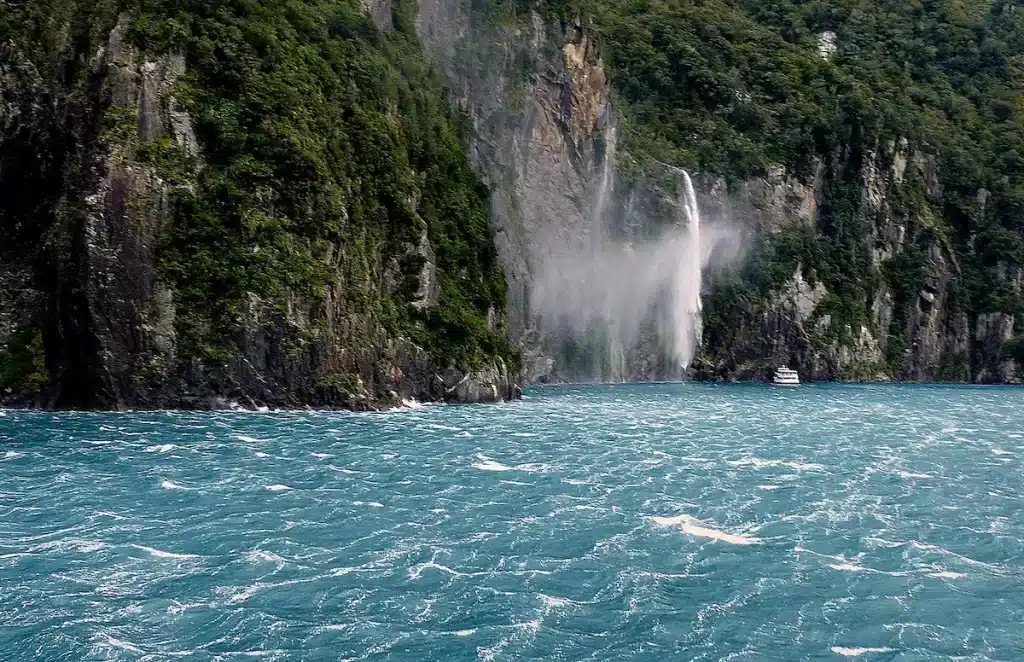
Above the surface, the drama continues. Kayakers often find themselves paddling through thick, floating mist, with waterfalls crashing beside them and fur seals dozing on the rocks. In winter, snow crowns the peaks, and the waterfalls grow wilder. Visitors to the place describe the cold season as a moody, magical time – quiet, raw, and soaked in nature’s theatre.
Don’t Just See It. Feel It.
Cruises are the most popular way to experience Milford Sound. These cruises take passengers past waterfalls like Stirling Falls — about three times taller than Niagara — and offer glimpses of dolphins, penguins, and seals. The crew often share tales about the area’s cultural and natural history, including Māori perspectives that describe the fiords as sacred places tied to ancient forces of nature.
For a closer, more immersive experience, try kayaking beneath towering cliffs in near silence. There’s also an underwater observatory tucked into the side of the fiord. Visitors descend into a chamber surrounded by glass, where they can see black coral and unique marine life without scuba gear.
The Hard Road In
Getting to Milford Sound is a trip in itself. The road from Te Anau winds through valleys, skirts alpine lakes, and disappears into the famous Homer Tunnel before revealing the fiord. Travel during winter conditions can be treacherous. Snow chains are often required, especially around the steepest sections. But what waits at the end is something otherworldly.
Milford Sound has barely any buildings. The so-called village consists of a lodge, a café, and housing for seasonal staff. There are no shops or flashy hotels. You come here to be small. To be soaked. To see waterfalls that hover mid-air.